Wednesday, October 27, 2010

What I've Been Up To -- Part II

 
After the Calgary-Banff Wordfest, the Half Brother book tour took me off to Victoria BC, my hometown, where I was very glad to see, finally, a statue of Emily Carr in the Inner Harbour, right in front of the Empress hotel. She has her monkey, Woo, on her shoulder.

I had a signing at the incomparable Munro's Books on Government Street, one of my favourite indepedant bookstores in the country. They put up a fancy red banner for me...


...gave my books a very flattering window display...
 

... and had a nice lineup of people waiting inside...

This is my intent signing face.

A highlight of the west coast book tour was getting to take my first harbour to harbour float plane, a Turbo Otter, from Victoria to Vancouver. Here's the ride...
And here's the pilot. I could actually see the altimenter and what he was dong the whole time. I think at one point he may have been scrolling through his iPod but I'm not sure...


It was sadly overcast when we approached Vancouver, but it was still a fine sight.


Here we are making our final landing approach in the harbour...


And a litle lower still... and then splashing down beside the Pan Pacific Hotel. Fantastic!


And then it was the Vancouver International Writers Festival where I did six events for groups like this:


Some highlights of Vancouver were meeting fellow YA authors Kevin Sylvester (also a CBC radio personality), and Australian writer Richard Newsome who has just released a really fun sounding book called The Billionaire's Curse. He was very funny. We shared an event in Vancouver -- here he is, doing his thing.


It was also great to catch up my long-time writer buddy Richard Scrimger, and we shared a panel with YA luminary Martha Brooks to talk about, um, writerly things. Another highlight was an impromptu breakfast with writer Yann Martel and his wife, YA author Alice Kuipers who, as the parents of an 18 month old, were up early and the only other people in the hotel dining room! They were there with Alice's parents, visiting from the UK, and I think they felt sorry for me, so they kindly invited me to join them. It was very pleasant to be included in a family breakfast after being away from my own family for so long. Oh, and the conversation was excellent!

And then home!

Wednesday, October 20, 2010

Hail Britannia! Advance love for HALF BROTHER


HALF BROTHER will be published in January in the United Kingdom by the fabulous David Fickling Books, which brought the world The Curious Incident of the Dog in the Night-Time, and The Boy in the Striped Pajamas. Even though my pub date is a few months away, we just got this advance review in the Bookseller magazine. I love it when this happens...

‘Kenneth Oppel’s standalone novel for young adults, HALF BROTHER, is a compulsively readable, extraordinarily gripping and moving book. Thirteen-year-old Ben’s world is turned upside down when his research scientist parents adopt a newborn chimp into the family to raise as a human child in an experiment to see if they can teach it to communicate using language. This is a meticulously researched book and the development of the experiment is very absorbing, but it’s Oppel’s ability to realise the complexity of Ben’s emotions towards his ‘half brother’ which makes it a triumph.’


--Lindsey Stainer, Blackwell’s, in The Bookseller, 15 Oct 2010

Monday, October 18, 2010

What I've Been Up To -- Part I

 For the past four weeks I've been travelling around Canada and the United States, talking up my latest novel, Half Brother. It started at the Telling Tales Festival in Rockton ON, at the fabulous Westfield Village heritage site, which is a restored Victorian town, complete with theatre, train station, pharmacy and general store. It was a beautiful day, packed with kids -- who didn't realize they were in for a stealth reading by Robert Munsch -- I could hear the screams of excitement all the way from the hospitality tent! Other authors and illustrators present included Jeremy Tankard (Grumpy Bird), Edward Wallace, Paul Yee and Linda Granfield.

Next stop was Chicago (Naperville ) where the wonderful independent bookstore, Andersons was holding its 7th annual YA literature conference for over 300 teacher-librarians. I was one of the featured speakers, and sat on a couple of panels with Pam  Munoz Ryan (her new book is called The Dreamer) and Brue Balliet (whose latest is The Danger Box). I got a chance to meet up with my editor (and fellow writer) David Levithan, and meet John Green (Will Grayson Will Grayson), and Charles Benoit who's written his first YA novel called You.

After that it was back to Toronto for Word on the Street, where I read at the Scotiabank Bestsellers Tent, and promptly boarded a plane and went to Houston for four days of school visits, and then on to the Austin Teen Book Festival.


 I was on three panels with fellow YA writers (from left to right); Susane Colosanti (Something Like Fate), Jon Skovron (Struts and Frets), keynote speaker Ellen Hopkins (Fallout) and Charles Benoit (You). It was great fun to get to know all these writers (I was the token Canadian) including James Dashner, whose Maze Runner has become such a huge hit.

It was my first time in Austin and it was a very pleasant surprise-- a vibrant city filled with music bars and restaurants -- and sidewalks! And people on them! Bikes, the headquarters for Whole Foods, and a fabulous independent store called BookPeople. There is also the Congress Avenue bridge which is home to 1,5 million bats. Supposedly they all swoop up into the sky at dusk, like an image from the Apocalypse-- I'd heard all about this while researching Silverwing over a decade ago. So naturally I went down to wait on the bridge with hundreds of other hopeful bat watchers and after an hour of waiting we were rewarded with -- nothing. The bats were a no show. I blame the easy availability of fast food.

 Next stop: Calgary for Worfdest, aways a favourite of mine, organized by the inimicable Anne Green,who will be stepping down as director this year. I was paired up with fellow YA writer Deborah Kerbel (whose new book is the ghost story Lure.) Originally we were sheduled to make one presentation at the 270-seat Vertigo Playhouse, but when that sold out, they added a second event, which sold out as well. So a third was added!

Me reading a selection of the novel to the kids...

Audience held spellbound by my presentation -- or just secretly revelling in the fact they're missing Math class.


After our Calgary events, Deborah (left) and I were taken up to Banff to do one last even at the Banff Centre for the Arts.
When I got up for breakfast, Banff looked like this...

Then after a few minutes it stopped raining and looked like this...

Then it snowed violently for a little while and looked like this...

So that was Calgary-Banff Wordfest. Check back for the next stops on the tour: Victoria and the Vancouver International Writers Festival....


Wednesday, October 13, 2010

Rejected chimps find shelter at Fauna Foundation

By KATHRYN GREENAWAY
The Montreal Gazette

Kenneth Oppel wanted to write a book for teens about chimpanzees - specifically about chimpanzees who were raised as humans in the 1960s and 1970s and taught sign language to communicate.

And he wanted to write about what happened to these chimpanzees when they were no longer cute babies and became too large to follow household rules.

The book is called Half Brother (HarperCollins), and the Governor General's Award-winning author did part of his research at the Fauna Foundation, a sanctuary for abused animals located just outside Chambly in the Monteregie region.

The sanctuary is home to 12 adult chimpanzees, most of whom were rescued from biomedical facilities.

"It was a really energizing trip," Toronto-based Oppel said of his visit to the Fauna sanctuary in 2008. "I learned so much about how chimpanzees behave in captivity, how they assert their domination.

"I was struck by their power and the power of their scent. You feel respectful. Some of them came close to have a look at me, and one tossed a green pepper at me."

There are about 600 chimpanzees in sanctuaries in the United States alone. Some of them worked in the entertainment industry, others were raised as pets, others came from zoos or were the offspring of chimpanzees used way back for space-travel experiments. Many come from biomedical facilities.

All chimps come to sanctuaries as damaged goods -traumatized by repeated scientific experimentation and extended periods spent in isolation and cramped quarters. Those raised by humans suffered the betrayal of being rejected and removed from familiar surroundings when they got too big or suffered from stress disorders from being forced to do tricks to entertain.

The Fauna Foundation has cared for 19 chimpanzees since veterinarian Richard Allan and Gloria Grow opened the facility in 1997. Seven chimpanzees have died. Their life expectancy is 40 to 50 years.

"It was beautiful to see how they were so loved by the staff. Gloria loves those chimps, and they don't have to do anything," Oppel said. "That is a great achievement because we all put conditions on how we love each other. That's an uncomfortable truth about human relationships."

Oppel had been kicking around the idea of writing a book about great apes for 20 years. He was inspired to start writing the book after reading the obituary of Washoe, a chimpanzee who was raised by humans and taught sign language in the late 1960s. Oppel also read about Sarah, a chimp who began learning sign language as part of a behavioural experiment during the same period. She now lives at a sanctuary in Louisiana and is 47 years old.

When Washoe became too large to control, she was taken from the only family she knew and placed in unfamiliar surroundings. She was 42 years old when she died in 2007.

In Half Brother, infant chimp Zan is ripped from his mother's breast (she is tranquilized at the time) and taken into the Tomlin household to be raised as a human and taught sign language. The Tomlins' teenage son Ben grows to love Zan and becomes his protector and saviour after the Tomlins shut down the sign-language experiment and ship Zan off to a horrible "sanctuary."

Not all sanctuaries are created equal. "Just like there are good doctors and bad doctors, there are good sanctuaries and bad sanctuaries," Grow said. "At the Fauna Foundation, we try to give the chimpanzees the peace and comfort they deserve after coming from such traumatic backgrounds."

Chimpanzees are our closest genetic relative. They have definite likes and dislikes and personalities.

The chimps at the Fauna sanctuary love to paint pictures, drink tea, eat spaghetti from a bowl and play with toys and trinkets. Colourful hair "scrunchies" are a hit right now, especially with alpha male Binky, 21, who likes to wear a neoncoloured scrunchy on his upper arm. (The scrunchies are so popular, a woman in Ontario sews extra-large ones so that they don't cut off circulation in the chimps' arms.)

The staff has also designed an enrichment program for the chimps. The recently introduced construction-work theme was particularly popular. The chimps had a blast playing with the toy tools.

They have fun, but they are also prone to moods, just like us, and that's when their size and strength can come into serious play.

"One of the biggest dangers is for people to think chimpanzees can be perfect and predictable pets," Oppel said. "I was in the middle of writing Half Brother when that horrible thing happened in the United States. Chimps are not meant to be pets."

Last February, Travis, an adult male chimp weighing 230 pounds, attacked a friend of his owner, blinding her and severing her nose, ears and both hands. Travis was shot by a police officer while trying to attack another officer.

The Fauna Foundation is located on 60 hectares and includes concrete buildings and a series of specially designed islands where the chimpanzees can hang out. The buildings are locked up tight to prevent escapes, and the area is surrounded by a powerful electric fence.

"Kenneth's book is great because it captures everything about a chimp's life in captivity, and it didn't turn into the Pollyanna world of chimpanzees," Grow said. "It's educational and it's based on fact. And he's written it for exactly the right audience. I recently did some work with students from Miss Edgar's and Miss Cramp's School. They were so engaged and wrote letters to (government officials) about the unethical treatment of chimpanzees. They are the generation that will change things. They are the ones that will read Kenneth's book and then talk about why it's not right to use chimpanzees in commercials."

Grow is one of the founders of the recently established North American Primate Sanctuary Alliance, an organization dedicated to the health and survival of quality sanctuaries for abused animals.

Is the Fauna Foundation accepting new chimps? "That's hard to say right now," Grow said. "It costs a lot to care for them ($250,000 a year) and they live a long time. We have to make sure the foundation is financially secure and that there are measures in place to care for the chimpanzees after we are gone. They are here for the rest of their lives."

Half Brother is in stores now. kennethoppel.com.

For information about donating to the Fauna Foundation, faunafoundation.org.

kgreenaway@montrealgazette.com

© Copyright (c) The Montreal Gazette

Monday, September 27, 2010

Ape becomes human; humans go ape

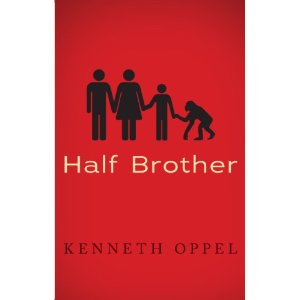
HALF BROTHER
Reviewed by Erika Ritter

From Saturday's Globe and Mail
Published Friday, Sep. 24, 2010

There is something particularly poignant in the plight of captive primates. Yet their similarity to us has never guaranteed them our compassion or respect – especially our closest relatives, chimpanzees. Mostly, we view them as human surrogates for cognitive studies, aeronautical experiments, invasive medical research and drug-testing, which we undertake solely for our benefit but would flinch from inflicting on ourselves. That’s when we’re not dressing these animals up as humans and laughing as they “ape” us in the circus ring or on TV.

Indeed, apart from the fortunate few who still live unmolested in the wild, chimpanzees inhabit a uniquely tragic in-between realm neither human nor strictly animal. Clearly, Kenneth Oppel gets that, right from the title of his latest young-adult novel, Half Brother, to the sober-sweet conclusion.

In previous works, such as the Silverwing and Matt Cruse series, Oppel has specialized in creating alternative realities for humans and animals. Half Brother, however, is set in a factually correct recreation of the early 1970s and modelled on real-life events. Nim Chimpsky was a chimpanzee raised from infancy in a human household and taught American Sign Language. The hope was that treating him like a human and giving him means to communicate with humans would determine that a non-human could acquire and employ language meaningfully. Ultimately, Project Nim was deemed a failure, and the poor chimp, stripped of his human clothes and celebrity status, was nearly sold to a research lab before animal advocates intervened to get him to a sanctuary.

Like Nim, Oppel’s fictional ape, Zan, comes to his human family as an infant, slated to be treated like a new baby. Unlike Nim, Zan is lucky that one member of his household becomes aware of how equivocal, perilous and ultimately untenable the position of a half-brother “adopted” for experimental purposes can be.

Ben Tomlin, our teenage narrator, is an only child initially upset because his father uprooted the family from Toronto to take up a university teaching and research post in Victoria. Rapidly, Ben’s upset turns to dismay when his mother (her husband’s research assistant) arrives at their new home with a week-old baby chimpanzee in her arms. With no more prior consultation than the animal himself received, Ben is expected to accept Zan as a sibling and to participate in the experiment of raising him and teaching him to sign.

Ben comes to love Zan and to view him as a fellow resister of adult tyranny. As both young males develop, Oppel draws comparisons between the means each finds to assert individuality and oppose authority. Ben adopts the posture of a “dominant male” in order to survive at his new school, as well as cope with his controlling father. Meanwhile, Zan begins to bristle, bare teeth and lash out when thwarted or challenged.

Despite his father’s scientific assertions and his mother’s tortured rationales, it’s clear to Ben that the chimp isn’t actually being treated like a human – not when he’s kept in a basement suite, drilled in ASL by brigades of grad students and strapped into a restraining chair if he misbehaves. It also becomes apparent that none of this is being done for the animal’s benefit. When Project Zan is shut down – for more or less the same reasons as real-life Project Nim – Ben is threatened with losing Zan to a prison-like primate facility.

Ben’s dilemma comes to parallel Jody’s in the classic novel The Yearling, by Marjorie Kinnan Rawlings. Like Jody, Ben must deal with a cuddly baby creature turned destructive adolescent, no longer able to be returned to the wild, yet no longer capable of being controlled like a domestic animal.

Oppel explores the limited options available, from the brutalities of research, to the exploitations of zoos, to the comparative humaneness of a primate sanctuary. Without ever becoming preachy, he makes the point that the initial dislocation of Zan and other members of wild species cannot ever lead to truly good outcomes.

Half Brother is fast-moving, engagingly told and smart. I hope today’s teen readers won’t be put off by its antediluvian setting in a period pre-text messages,

Facebook and cellphones, with a soundtrack by ABBA and Elton John. Actually, not much has changed for apes in North American research facilities over the past four decades, and, come to think of it, ABBA and Elton are still with us, along with Planet of the Apes movies and heated debates on animal rights.

Beyond Ben’s unique preoccupation with Zan, Oppel takes pains to give his protagonist more typically adolescent concerns. As an adult, I confess I found the teenage-angst aspects of the novel fairly run-of-the-mill. That might be the limitation of a young narrator’s perspective on his own standard-issue anxieties – as compared to his vivid accounts of his extraordinary relationship with an animal through sign language.

Ultimately, this novel is about much more than an abandoned experiment in interspecies communication. Through Ben, Oppel gracefully underscores the true value in reaching Zan: Not to profit from teaching him to perform tasks, but to grasp the world as a non-human perceives it.

Erika Ritter is the author most recently of The Dog by the Cradle, the Serpent Beneath: Some Paradoxes of Human-Animal Relationships, now available in paperback.

My Books My Place

Kenneth Oppel plays the library card
From Saturday's Globe and Mail
Published Friday, Sep. 24, 2010

I don’t actually spend much time here, but I really should. The book-lined room has an incredibly comfortable chair that I picked myself, a scholarly refectory table, beautiful ceiling mouldings and even an antique globe. Any self-respecting writer should be permanently ensconced here with a pipe and a glass of port.

The truth is, I read mostly on my bed, where I can sprawl out and easily go unconscious. But I hereby resolve to spend more time in my library and finish the last pages of my current read, John Updike’s Rabbit, Run.

As a teenager, I read Updike’s first short-story collection, The Same Door. A Hemingway devotee, I’d marvelled at his crystalline prose and the authenticity of his characters and scenes. Wanting more, I got a second-hand copy of Rabbit Redux, not realizing it had a predecessor (and later would have a successor). It didn’t matter: Although Updike’s prose had become more jewelled and a bit less lithe, my 16-year-old self still loved reading about Rabbit Angstrom and his incredibly weird and smutty life.

But for some reason, though I’ve read and admired many of Updike’s other works, I never got around to reading the first Rabbit until now. Just before this, I devoured Mordecai Richler’s The Apprenticeship of Duddy Kravitz – another grievous omission in my reading life. Like Rabbit, Run, it was written in the late fifties, by a writer in his mid-20s – but the heroes, though both careening, are polar opposites. Duddy is all manic action; Rabbit, a study in passivity. Richler’s novel bursts with energy; Updike’s offers a more sedate, penetrating character study.

I love Updike, but I’ve got to say, Duddy Kravitz wins my vote: I like heroes with restless hearts and big passions, who make things happen.

Friday, September 10, 2010

Writing Half Brother

Published in the Huffington Post

Writing Half Brother: Love, Control, and Talking Animals

I only recently realized how fitting (and possibly ironic) it was that, after writing four bestselling “talking animal” fantasies featuring bats (the Silverwing series), I’d go on to write a realistic novel about an animal who truly did talk.

The seed for my novel Half Brother was planted in my mind over twenty years ago, but didn’t germinate until late 2007 when I came across the obituary for Washoe, an extraordinary chimpanzee who had learned over 250 words of American Sign Language.

It wasn’t the first time I’d heard about Washoe, or the radical language experiments performed on chimps in the 1960s and 70’s. As a first year undergrad at the University of Toronto, I’d read with fascination about Project Nim, in which a baby chimp was raised as a human child to determine whether chimps were capable of learning human language. Nim was dressed in diapers and clothes, he ate at a high chair, had books and toys -- and a very large surrogate human family.

At first blush, the experiment had a beguiling Doctor Dolittle charm to it – an attempt to communicate with another species in a truly meaningful way. Not nearly so charming was what happened when the experiment ended two years later – after being deemed a failure. Nim was abruptly stripped of his human identity, his clothes and toys and favourite foods, separated from the people he’d come to think of as mothers and fathers and siblings, and shipped off to another primate research institute. I found the image of Nim, looking out through the bars of a cage, incredibly sad – and I’d never considered myself someone who was sentimental about animals.

When, years later, I read Washoe’s obituary, I wondered what it would be like to write a story from a chimpanzee’s perspective. When I’d written my Silverwing series -- I’d imbued the bats with full human awareness and vocabulary. But what would it be like to try to tell a story with only the words Nim or Washoe had learned? The idea had a powerful appeal, but I decided that limiting myself to a two-hundred-and-fifty-word vocabulary – heavy on nouns, and light on verbs – would probably create something that might generously be called brave and avante-garde; or ungenerously, an unreadable mess.

Any attempt to write from an animal’s perspective inevitably involves anthropomorphization, and with Half Brother I wanted to steer clear of that. In the end I chose to tell the story through human eyes – those of Ben, a teenager whose father is a hotshot behavioural psychologist conducting a language study with a baby chimpanzee called Zan, in the family home.

Certainly I was interested in the controversial animal rights issues inherent in the story – chimps have been used and abused by humans in the entertainment industry, the US Space Program, and, perhaps most upsetting, the biomedical research industry. But equally fascinating to me were the human dynamics of the story. Imagine, as a teenager, being told to treat a chimp like a baby brother, while never forgetting that it was also a lab specimen. Imagine watching your mother and father indulge in a bizarre form of parenting – one in which the baby was nurtured, but also emotionally manipulated, and ultimately coerced into performing. To the father, the baby is only of value as long as it gives him what he needs.

But is human parenting -- or human relationships in general -- so very different? The more I worked on Half Brother, the more it seemed to me the story was really about love in all its possible forms – how and why we decide to bestow it, or withdraw it; how we decide what is more worthy of being loved, and what is less. We are masters of conditional love.

During my research for Half Brother I read numerous accounts of people who had worked with chimps and many of them, I believe, truly did love the animals, and were heart-broken when they were separated from them. One of the most moving experiences I had was visiting the Fauna Foundation, a chimp sanctuary outside Montreal, which is home to thirteen chimpanzees who have been “retired” from zoos, the entertainment industry, and biomedical research facilities. These chimps, no longer deemed “useful” by their previous owners, now have a wonderful home where they are cared for by director Gloria Grow and her staff. Some are old and ill, some are HIV positive as the result of medical research. But they no longer have to perform or deliver, and it was clear to me that they were truly and unconditionally loved.