Showing posts with label Half Brother. Show all posts

Wednesday, June 8, 2011

Ruth and Sylvia Schwartz Awards 2011


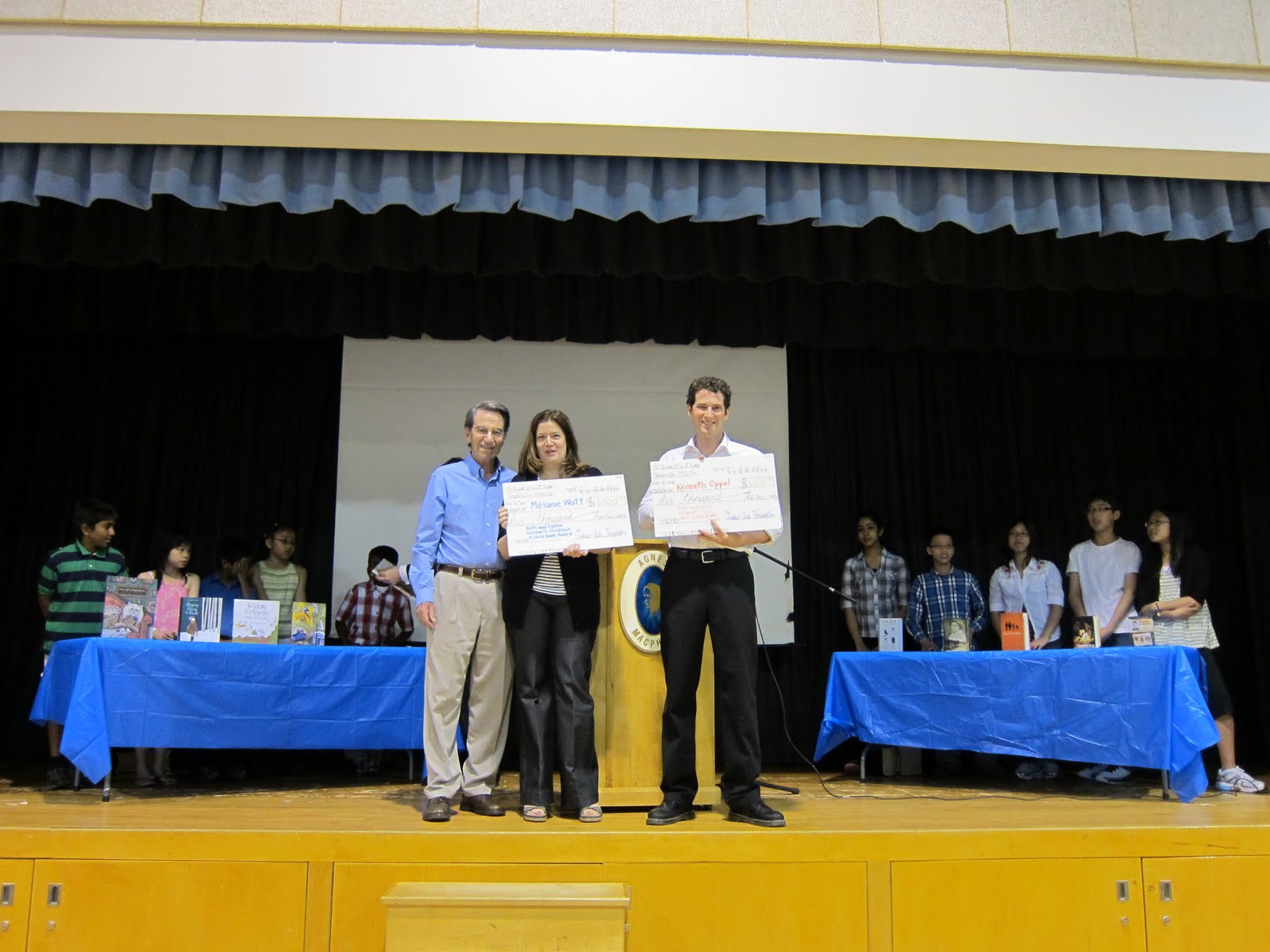
Melanie Watt (best picture book winner for Chester's Masterpiece) and I pose with our impractically large prize cheques Our respective juries are off to either side: amazing kids who read, discussed, debated and chose the winning book from a shortlist of five!

Melanie Watt and I with the Solways, the relatives of Ruth and Sylvia Schwartz, the esteemed Toronto booksellers after whom the award is named.

Will it fit into the ATM or will I actually have to talk to a teller?


Doing a quick reading of HALF BROTHER in which Ben gets peed on by a baby chimp. Went down well I think.

Wednesday, March 2, 2011

Half Brother optioned for film

By Jeff Sneider
Reprinted from Variety

Producers Christian Taylor ("Hick") and Eva Orner ("Taxi to the Dark Side") have optioned Kenneth Oppel's young adult novel "Half Brother."

Set in the 1970s, the coming-of-age story explores the bond between a teenage boy and a chimpanzee, as well as the ethical implications of animal research. Raised by the boy's family as part of a study, the chimp quickly becomes a media sensation, but when the project loses its funding the teen must risk everything to save the animal.

Producers are in the process of finding a writer and distribution partner for the project, which is said to feature a magical quality reminiscent of "E.T."

Scholastic/HarperCollins published "Half Brother." named a 2011 Best Book for Young Adults by the American Library Assn.

Summit Entertainment recently acquired rights to Oppel's upcoming novel "This Dark Endeavor: The Apprenticeship of Victor Frankenstein," which Karen Rosenfelt ("Twilight") is on board to produce.

Taylor is producing "Hick," an indie pic that will star Chloe Moretz, Blake Lively and Eddie Redmayne.

Oppel's publishing rep is Writer's House, while Rosen Feig Golland and Lunn repped Taylor and Orner in the deal. Richard Shepherd represented film rights on the project.

Friday, January 28, 2011

The Uncomfortable Bits

There’s a scene in my new book, Half Brother, that some people have found very uncomfortable. I won’t tell you what it is; you’ll have to read the book to find out – and maybe you won’t find it uncomfortable at all. But it’s made me think about how differently people can respond to the same material – and most importantly, how much I’ve come to appreciate those moments – in a movie, or a book, or simply watching Ricky Gervais host an awards show – that have pushed me beyond my comfort zone, or violated my expectations in some way.


Because it’s inevitably these moments that stay with me the longest. It might be something as simple as the scenes in the movie Castaway where Tom Hanks names and starts talking to the volleyball – annoyingly absurd I thought at the outset, but then realized how brilliant and moving it was – a man so lonely and desperate to cling to sanity, he finds companionship however he can. Or the scene in Kenneth Branagh’s adaptation of Frankenstein where, having birthed the creature, he’s unable to lift its giant frame from the floor, and staggers and slips about for a prolonged period in a slick of “amniotic” fluid – at first it seemed farcical and gratuitously slimy, but then in my mind it became brilliantly primal, and a metaphorical wrestling with the boundaries of science and morality. Or it might be the literal ringing of bells in heaven when the heroine is “martyred” at the end of Breaking the Waves – a moment which several of my friends said utterly ruined the entire movie for them, but which I think is brilliant.

At their best, uncomfortable moments aren’t just shocking and interesting; they can challenge our convictions. As readers, viewers, citizens, we tend to prefer the same menu. There’s a comfort in it, a sense of security, but sometimes also an almost self-righteous complacency: See, everyone thinks exactly the same thing as me! But what I think is so valuable about a work of art is how it can confront you with a new opinion, a new moral or political idea, that you’d never considered. Novels as disparate as Never Let Me Go, Cider House Rules, Feed, Frankenstein, and Wolf Hall have introduced me to new and uncomfortable ideas, and forced me to think about life in different ways – and while my personal reactions and reflections might not have been those intended by the author –perhaps quite the opposite in some cases – the important thing is the process: an opening to ideas rather than a closing.

So, long live uncomfortable scenes!

By the way, here's some of what Patrick Ness said about Half Brother in his recent review in The Guardian:

"Oppel is pleasingly unafraid to ask awkward questions, often right at the point where readers might have made up their minds. What a particular joy for a teenage reader, to be challenged rather than instructed. Parents might be surprised at the passionate discussions Half Brother ends up inspiring, along with a healthy new respect for our closest genetic cousins." – Patrick Ness in The Guardian, 22.1.11

Friday, September 10, 2010

Writing Half Brother

Published in the Huffington Post

Writing Half Brother: Love, Control, and Talking Animals

I only recently realized how fitting (and possibly ironic) it was that, after writing four bestselling “talking animal” fantasies featuring bats (the Silverwing series), I’d go on to write a realistic novel about an animal who truly did talk.

The seed for my novel Half Brother was planted in my mind over twenty years ago, but didn’t germinate until late 2007 when I came across the obituary for Washoe, an extraordinary chimpanzee who had learned over 250 words of American Sign Language.

It wasn’t the first time I’d heard about Washoe, or the radical language experiments performed on chimps in the 1960s and 70’s. As a first year undergrad at the University of Toronto, I’d read with fascination about Project Nim, in which a baby chimp was raised as a human child to determine whether chimps were capable of learning human language. Nim was dressed in diapers and clothes, he ate at a high chair, had books and toys -- and a very large surrogate human family.

At first blush, the experiment had a beguiling Doctor Dolittle charm to it – an attempt to communicate with another species in a truly meaningful way. Not nearly so charming was what happened when the experiment ended two years later – after being deemed a failure. Nim was abruptly stripped of his human identity, his clothes and toys and favourite foods, separated from the people he’d come to think of as mothers and fathers and siblings, and shipped off to another primate research institute. I found the image of Nim, looking out through the bars of a cage, incredibly sad – and I’d never considered myself someone who was sentimental about animals.

When, years later, I read Washoe’s obituary, I wondered what it would be like to write a story from a chimpanzee’s perspective. When I’d written my Silverwing series -- I’d imbued the bats with full human awareness and vocabulary. But what would it be like to try to tell a story with only the words Nim or Washoe had learned? The idea had a powerful appeal, but I decided that limiting myself to a two-hundred-and-fifty-word vocabulary – heavy on nouns, and light on verbs – would probably create something that might generously be called brave and avante-garde; or ungenerously, an unreadable mess.

Any attempt to write from an animal’s perspective inevitably involves anthropomorphization, and with Half Brother I wanted to steer clear of that. In the end I chose to tell the story through human eyes – those of Ben, a teenager whose father is a hotshot behavioural psychologist conducting a language study with a baby chimpanzee called Zan, in the family home.

Certainly I was interested in the controversial animal rights issues inherent in the story – chimps have been used and abused by humans in the entertainment industry, the US Space Program, and, perhaps most upsetting, the biomedical research industry. But equally fascinating to me were the human dynamics of the story. Imagine, as a teenager, being told to treat a chimp like a baby brother, while never forgetting that it was also a lab specimen. Imagine watching your mother and father indulge in a bizarre form of parenting – one in which the baby was nurtured, but also emotionally manipulated, and ultimately coerced into performing. To the father, the baby is only of value as long as it gives him what he needs.

But is human parenting -- or human relationships in general -- so very different? The more I worked on Half Brother, the more it seemed to me the story was really about love in all its possible forms – how and why we decide to bestow it, or withdraw it; how we decide what is more worthy of being loved, and what is less. We are masters of conditional love.

During my research for Half Brother I read numerous accounts of people who had worked with chimps and many of them, I believe, truly did love the animals, and were heart-broken when they were separated from them. One of the most moving experiences I had was visiting the Fauna Foundation, a chimp sanctuary outside Montreal, which is home to thirteen chimpanzees who have been “retired” from zoos, the entertainment industry, and biomedical research facilities. These chimps, no longer deemed “useful” by their previous owners, now have a wonderful home where they are cared for by director Gloria Grow and her staff. Some are old and ill, some are HIV positive as the result of medical research. But they no longer have to perform or deliver, and it was clear to me that they were truly and unconditionally loved.